The Rise of Algorithmic Trading in Crypto
By 2026, an estimated 70-80% of all cryptocurrency trading volume is executed by algorithms and bots. This isn't a new phenomenon. In traditional finance, algorithmic trading has dominated for decades. But crypto's unique characteristics make it particularly well-suited for automated trading: 24/7 markets (no human can watch charts every second), high volatility (more opportunities), API access (exchanges built for bots), and transparent order books.
AI trading bots range from simple rule-based systems ("buy when RSI is below 30") to sophisticated deep learning models that process thousands of data points simultaneously. Understanding how they work helps you evaluate which bots are legitimate and which are just marketing hype.
Types of Trading Bots
1. Rule-Based Bots (First Generation)
The simplest type. These follow pre-programmed "if-then" rules: "If RSI drops below 30 AND MACD crosses bullish, buy." They're easy to build but have a fatal flaw: markets change. A rule that works in a trending market will get destroyed in a ranging market, and vice versa. These bots can't adapt.
2. Statistical / Quantitative Bots (Second Generation)
These use statistical models like mean reversion, statistical arbitrage, and market-making strategies. They analyze historical patterns and probabilities rather than fixed rules. More sophisticated, but still limited to patterns they were programmed to recognize.
3. Machine Learning Bots (Third Generation)
ML bots can learn from data and improve over time. They use techniques like:
Supervised LearningTrained on historical data labeled with outcomes (profitable/not profitable trades). The model learns which patterns lead to success.
Reinforcement LearningThe bot learns by trial and error in a simulated environment, being "rewarded" for profitable actions. Similar to how AlphaGo learned to play Go.
Neural NetworksDeep learning models (LSTMs, Transformers) that can process sequential data like price charts and identify complex, non-linear patterns humans can't see.
Ensemble MethodsCombining multiple models that "vote" on trade decisions. If 3 out of 4 models agree on a signal, confidence is higher. Reduces individual model errors.
4. Deep Neural Network Bots (Fourth Generation)
The most advanced category, used by institutional traders and modern platforms like CryptOn. These bots combine multiple AI architectures: convolutional neural networks (CNNs) analyze price chart patterns visually, recurrent networks (LSTMs/GRUs) process time-series data, attention mechanisms weigh which indicators matter most in the current market regime, and transformer models process multiple data streams simultaneously.
How a Modern AI Trading Bot Works: Step by Step
Step 1: Data Ingestion
The bot continuously collects data from multiple sources in real-time:
Price DataOHLCV (Open, High, Low, Close, Volume) candles across multiple timeframes (1m, 5m, 15m, 1H, 4H, 1D)
Order Book DataBid/ask depth, order flow imbalances, large wall detection
Derivatives DataFunding rates, open interest, long/short ratios, liquidation levels
On-Chain DataExchange inflows/outflows, whale wallet movements, network activity
Step 2: Feature Engineering
Raw data is transformed into meaningful features. This is where technical indicators come in. The bot calculates RSI, MACD, Bollinger Bands, ATR, EMA crossovers, and dozens of other indicators across multiple timeframes. It also creates derived features like rate of change, momentum divergences, volatility percentiles, and cross-timeframe correlations.
A sophisticated bot might generate 200-500+ features from the raw data. Not all are useful. Feature selection algorithms identify which features have real predictive power and discard noise.
Step 3: Signal Generation
The processed features are fed into the AI model, which outputs a trading signal with a confidence score. This isn't a simple "buy/sell" but rather a probability distribution: "There's a 73% probability of a 2%+ upward move within the next 4 hours, with a 15% probability of a 1%+ downward move."
The bot then applies a minimum confidence threshold. If the signal confidence is below the threshold (e.g., 65%), it passes. No trade. This patience is crucial and something human traders struggle with. A well-designed bot might only trade 2-5 times per day because it's waiting for high-probability setups.
Step 4: Risk Assessment
Before executing, the bot runs a risk check:
Current market volatility (ATR) → Determines position size and stop-loss distance.
Existing open positions → Checks total portfolio exposure isn't exceeded.
Correlation check → Ensures new trade isn't too correlated with existing positions.
Drawdown check → If the account is in a drawdown, it may reduce size or pause trading.
Funding rate check → Avoids entering positions where funding would erode profits.
Step 5: Execution
The bot connects to the exchange via API and executes the trade. Good bots use sophisticated execution strategies:
Limit orders rather than market orders when possible (to avoid paying the spread). Order splitting for larger positions (to avoid moving the market). Slippage protection (if the price moves more than X% between signal and execution, cancel). Retry logic with exponential backoff if the exchange API is slow.
Step 6: Trade Management
After entering, the bot continuously monitors the position:
Dynamic stop-loss: Adjusts based on current volatility and price structure. May use a trailing stop in strong trends.
Partial profit-taking: Takes some profit at intermediate levels to lock in gains while letting the rest run.
Re-evaluation: Continuously re-runs the model to check if the trade thesis is still valid. If conditions change significantly, it may close early even before stop-loss or take-profit is hit.
How to Evaluate an AI Trading Bot
Not all bots are created equal. Here's what to look for, and what to avoid:
| Green Flag ✅ | Red Flag 🚩 |
|---|
| Transparent live track record with verified trades | Only shows backtest results (easy to overfit) |
| Non-custodial (your funds stay in your exchange) | Requires you to deposit funds into their platform |
| API with trade-only permissions (no withdrawals) | Asks for withdrawal permissions on API key |
| Realistic return claims (5-15% monthly) | Promises 50%+ monthly returns or "guaranteed profits" |
| Explains the strategy methodology | "Secret AI" with no explanation of how it works |
| Shows losing trades too | Only shows winning trades |
| Has clear risk disclosures | No mention of risk or downside |
| Monthly subscription (aligned incentives) | Requires large upfront payment |
The Advantages of AI Over Human Trading
No EmotionsNever experiences fear, greed, FOMO, or revenge trading. Follows the system with 100% discipline every single time.
24/7 OperationCrypto never sleeps. A bot catches opportunities at 3 AM that you'd miss. No fatigue, no breaks needed.
Speed & PrecisionAnalyzes hundreds of data points and executes in milliseconds. By the time you pull up a chart, the bot has already acted.
Consistent Risk ManagementNever moves a stop-loss because "it'll come back." Never overlevers because of a hunch. Mathematical precision, every trade.
The Limitations of AI Bots
It's important to be honest about limitations too:
Black swan events: AI models are trained on historical data. Truly unprecedented events (exchange hacks, regulatory bans, protocol failures) can cause losses that no model predicted. Good bots mitigate this with hard stop-losses and maximum drawdown limits.
Regime changes: Markets can shift from trending to ranging to chaotic. A model trained primarily on one regime may struggle in another. The best bots use adaptive models that detect regime changes and adjust strategies accordingly.
Overfitting: A model that performs perfectly on historical data may fail in live trading if it was "overfit" to past patterns that won't repeat. This is why forward testing (live trading with real money) is the only true validation.
How CryptOn's AI Bot Is Different
CryptOn uses a fourth-generation deep neural network architecture that processes 16+ technical indicators across multiple timeframes simultaneously. The key differentiators:
Multi-model ensemble: Multiple AI models must agree before a trade is taken, reducing false signals. Adaptive regime detection: The bot identifies whether the market is trending, ranging, or volatile and adjusts its strategy accordingly. Live since 2022: Over 3 years of forward-tested, real-money performance, not just backtests. Non-custodial architecture: The bot connects to your Binance account via API with trade-only permissions. Your funds never leave your wallet and withdrawal is impossible through the API.
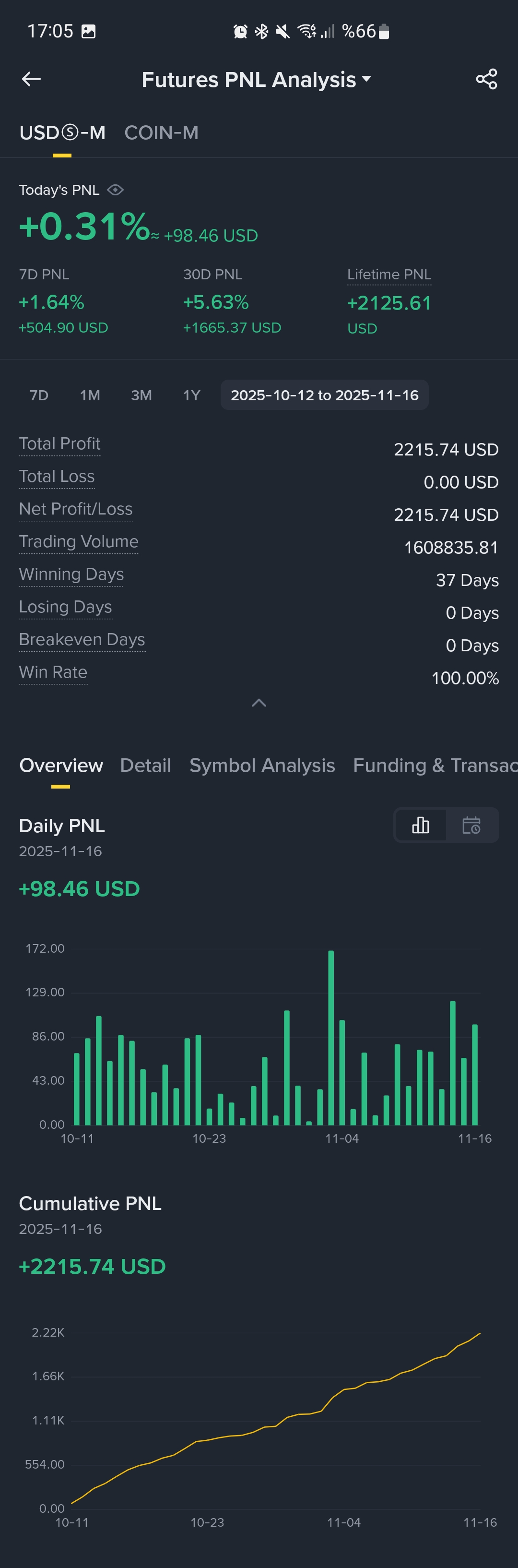
See It In Action: Check the Live Trades section on this page to see the bot's actual open and closed positions with real PnL data. Every trade is shown transparently, wins and losses alike.




Live Social Sentiment & Trending Coins
Real-time tracking of which coins are buzzing across crypto communities. Market moves often start here - spot the next breakout before it happens. What LunarCrush charges $49/month for, free here.
Live data from CoinGecko Trending API | Refreshes every 5 minutes | Social scores based on search rank, market cap rank delta & community activity